The Glorious Twelfth –
What working setters are really all about
 On Lochan Estate
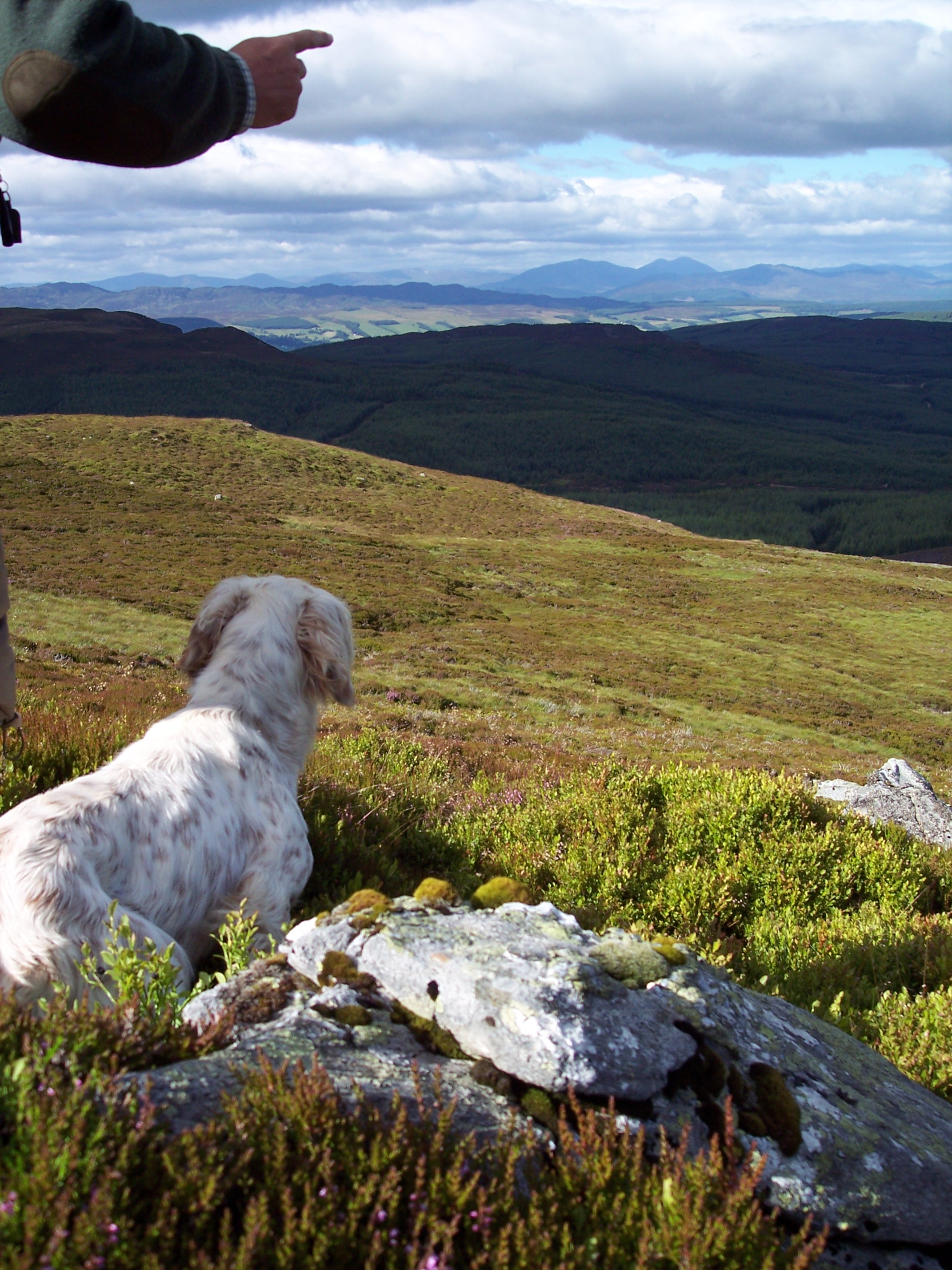
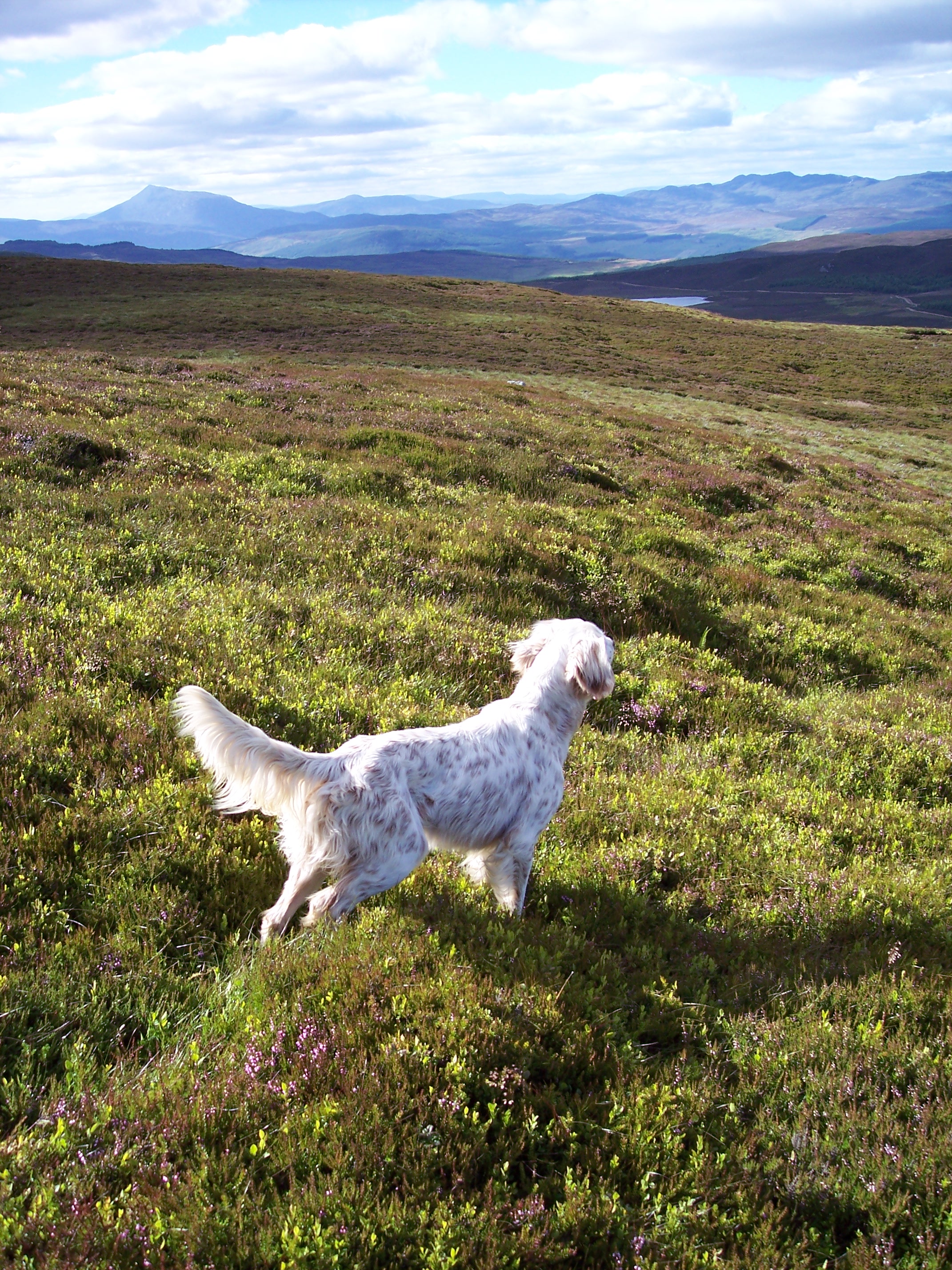
Gardenfield Warrior is shown setting and producing a covey of grouse in brilliant August weather
I’ve always kept working dogs – terriers, lurchers, setters and German Pointers, but I’ve been particularly serious about Setters since the early 1990’s. The turning point for me was probably when I saw the cover of Shooting News in March 1990 which featured a photograph of John Geoghegan and his first Norwegian import Storeskars G’Snorre. I rang Johnny and had a long chat about the state of English Setters. Johnny was still in the early days of his development programme for the breed, but he was already achieving tremendous results. He suggested I come and see the dogs at the up-coming Trials in Galway. Up until then my main experience of Trials had been the pheasant Stakes run by the Ulster Irish Red Setter club and then the Donegal Field Trials Association also on my home ground of Raphoe. I’d helped out at the venue, carried the gun and even by then managed to win an Open Stake with my first competitive setter Louis (from the King of the Dandies line). The trip to Galway paid off, I was treated to a display by Johnny’s team of dogs and I particularly remember Tony O’Connell running “The Missile”, an absolute flying machine of a little bitch. I was hooked, Louis soon departed the kennel for a shooting home, and I’d got the blueprint for the type of dog I wanted to train and handle. Ardvalley Flight (Storeskars G’snorre x Hypericum Lass bred by Enda Craig of Moville) appeared on the scene and he was able to perform in the way I’d seen Johnny and Tony’s dogs do in Galway. I had arrived !! Flight became an Irish Champion and also won an Open Stake in Northern Ireland before I retired him from competition at the age of five. I’ve had a succession of dogs since, with a couple of effective Irish Red Setter bitches along the way, but the bottom line is – if they don’t have the potential to raise the blood pressure and make the heart skip the odd beat, they don’t last long in the kennel.
Now the second very key development in my story is also down to Johnny Geoghegan. He invited me to accompany him on what was to be the first trip of many to his English stamping ground in Co. Durham. This part of the world is really heaven on earth for those involved with bird dogs. Grouse exist in serious quantities – the names of the moors in the area are legends: Bollihop, Eggleston, Stanhope and Blanchland to mention just a few. The birds here make the training of dogs very easy, or if easy is not the most accurate word, at least allow you to sort out the chaff from the grain as the dogs which really don’t have game sense can be sifted out and relegated from the team in a way that is much more difficult in Ireland. Let’s face it, these dogs and their Irish and Gordon cousins and the Pointer were developed to earn their living producing game. It’s very easy when only involved in Field Trials to get caught up with having dogs where speed and wide running are the number one priorities. You can totally forget that it doesn’t matter how far or how fast the dog goes, if he doesn’t have a nose and take the game when he has the opportunity, he will only ever be mediocre. And it is so easy to be deluded by a dog with pace here at home, where game chances are relatively few, so excuses can be made if a dog seems to fluff the chances he gets. In England this just ain’t so!! The opportunities for points are so frequent that the dog which just can’t handle game quickly becomes apparent and the decision to replace him can be made – years perhaps of disappointment can be saved by one trip to the English moors.
And then I discovered Scotland . . . it’s a different place to both Ireland and England. The Moors I’ve been lucky enough to get access to have keepers and lairds who are welcoming and professional (unlike the midges in Scotland who might be professional in their approach, but are far from welcoming and present in such quantities as to be complete torture!). Grouse are not generally as plentiful as in England, so the dogs get more chance to run, but they’re still present in such numbers as to make training a treat. I’ve taken the team to several big estates in recent years to undertake what having dogs is all about – dogging for the guns (by the way when I say big, I mean BIG! On one estate when I arrived at the Lodge to meet the team of American guns, the keeper told me not to be getting the dogs out as we had a wee drive out to where we were going to work. We were already several miles off the main road on estate property and we set off in convoy through their best driven ground. The wee drive turned out to be a little over 13 miles of fairly straight mountain track and we were still well off their western boundary!!)
As for a day’s dogging, it’s amazing how quick the older, more experienced dogs settle to the job, it’s as if they realize the Trials have been the dress rehearsal and now it’s time for the serious business. There’s a great pleasure to be got from seeing the Field Trial Champion spend the day raking the hill for the guns, in observing the way their natural instincts kick in and they make the necessary adjustments in speed and can read and work the wind from any angle. These dogs do the majority of the work – the dog boy brings 3 or 4 others so that frequent changes can be made to preserve their enthusiasm and freshness.
The old hands are the dogs which carry the majority of the working day, but when things are going well and the bags are filling nicely you get the opportunity to let the young dog off for the first time. To go up to a young dog’s first find with a brace of Guns and see the covey rise and the guns drop one or two birds in front of him is an unforgettable experience, you can almost see the penny drop in him as he quickly begins to appreciate the difference in this experience and all those training days and realize what they were all for. To see the young dog mature before you eyes in the space of a couple of finds – that alone makes the trip worthwhile. I’ve always shot over my own dogs, but the only chance they have for grouse is in Scotland – and that’s what makes a dog. However pleasing a find is on snipe or pheasant, the find on the heather when he’s had a stunning run and the covey rise before him is unbeatable.
The accents carrying the guns can be anything from Italian to American, Scots to English, but one of the great things about dogging is the leisurely pace at which it’s conducted. There’s usually ample time between points to chat with the guns about the dogs and their work, if they’re interested and many are (you get an idea of just how caught up they get with the dogs when you go out to a point and find they’re aiming a camera at you and the dog rather than an expensive 12 bore at the grouse!!). The magnificent scenery, glorious weather (hopefully), the accompanying team of keepers with labs or springers, perhaps the pony-man and his garron – these all combine to give the day a great atmosphere. The guns who book their day’s dogged grouse shooting year after year are the ones who have come to appreciate all of the above. They quickly get to know the individual dogs in the team and pick their favourites. Three years ago the Americans favoured Ballyellen Bettina, my white ESB off the original Norwegian dog (Storeskars G’Snorre) and Bill Connolly’s upper International F.T. Ch Lefanta Patsy. Bettina just didn’t make a mistake the whole time and ran without flagging occasionally being relieved by their second choice Toryview Archie (bred by Liam Law) who that year was a pup who went from having his first find for the guns carrying a check cord (just in case) to being faultless too. The rest of the team played their part, but these two were the stars. The following year Bettina wasn’t really fit and Archie carried the show with Tim (soon to be Int.F.T.Ch Gardenfield Warrior) coming into his own. Archie was really canny around his birds. A typical shooting day is often carried out by walking in a large circle away from and then back to the vehicles. This means even on a day with a steady true wind, about 50% of the day will have awkward wind conditions, it gets really interesting on days when the wind is light or erratic! Archie was totally un-phased by this and naturally made the adjustments to cover the ground effectively and find his birds. Most of that season was with a large team of Italian guns (they were English Setter men too, one had even brought his dog with him from Italy for the trip) who chatted about the dogs, quickly identifying the ones they preferred to see. When the dog points the handler takes two guns in to the point, one on each side, so there was always an eagerness on the guns’ part to see which dog was down to run when it was their turn to shoot. Last year the red setter sibling duo of Misty (FTCh Princess Nisha) and my brother Ned’s Max (Obbie) seemed to particularly catch the guns’ attention. The shooting weather was stiflingly hot, birds were hard to locate and difficult to produce – Bettina was incredibly unfit but when let off the lead to potter about, even when another dog was out in front working, had a really uncanny knack of just toddling our and producing difficult birds which had tucked in tightly in the very hot conditions, hoping to fool the dogs. On my second tip last year we were working for the estate owner and his family and guests rather than paying guns. The atmosphere was very relaxed and the weather had cooled from the previous week making it so much more comfortable for dogs and humans alike, the grouse were much more obliging and we concluded the 2003 season on a very positive note.
So now in May 2004 the feet are already itching at the thought of the trips to the Highlands. Unfortunately reports were not great in the Spring but we’re having a decent May so maybe the birds will have a good chance in their breeding season. Every time I get a chance to speak to one or other of the boys from Scotland, be it John Kerr, that Irish Setter enthusiast from Aberdeenshire or Perthshire’s Lawton Evans, a real professional with all types of working dogs, who I’ve a great respect for, or any of the keepers, they’re pumped for information about the conditions and predictions for the year.
And with the Trials less than 2 months ahead there’s plenty of work to do getting the experienced dogs (and self!) fit and back under control and bringing on this year’s crop of novices and pups for a very active time during the Trial seasons and of course the highlight of my year – The Glorious Twelfth!
By Gerald Devine 2004
 The English Setter from Ireland