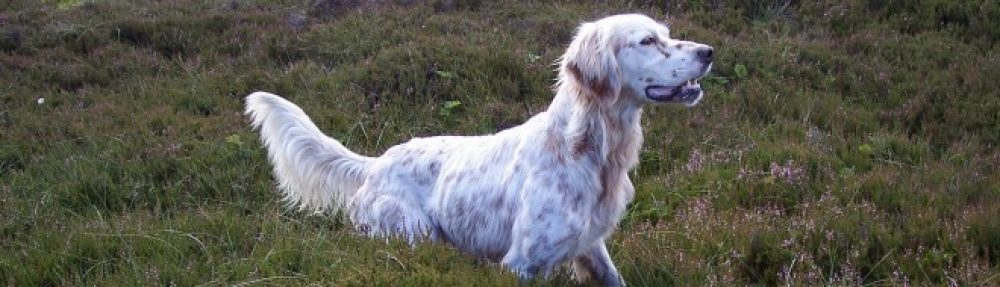
The Red Mills 2013 interview –
Nigel Carville talks to Gerald Devine
- Can I take you right back to the start and ask you what was your first dog and when and how you acquired it?
My first dogs were terriers and lurchers which I got interested in as my brothers had them and I was brought up with them.
- When did you purchase your first setter for trialling and what was their breeding and name?
My first English Setter to be entered in a Field Trial went by the name of Louie. He was bred from the King of the Dandies line by a local garda sergeant Jackie Conaty. However the first dog I acquired purely for trialling, having seen Johnny Geoghegan’s dogs run ,was Ardvalley Flight, a son of Storeskars G’Snorre, who became my first champion.
- What is your prefix and why did you choose it?
Gortinreagh is my prefix. It is the name of the townland where I live.
- Where and when was the first trial you ran in and how did you get on?
The Ulster Irish Red Setter Club and Donegal Field Trials Association had been running trials for years on the farmland around Raphoe under the control of Raphoe Gun Club. I had helped out at the Trials, carrying the gun and so on for several years when I decided to enter Louie in the up-coming event in 1990. He had a good find on a pheasant and put in some nice running to be awarded the Open Stake at my first attempt.
- With which dog did you win your first Trial and what ground and what quarry?
Louie, as I’ve just explained, recorded my first win at my home Trial.
- How many Trials have you won?
I haven’t kept a record of wins. I generally only run trained dogs on for a season or two after they achieve their title at most, as I get more fun out of bringing on young dogs, so I’m sure if I had kept dogs like IntFTCh Gardenfield Warrior running for longer I would have recorded significantly more wins than I have.
- How many champions have you made up? What are their names?
To date I have made up 13 Field Trial Champions (10 English Setters and 3 Irish Red Setters) – some were lucky enough to become both Irish and GB Field Trial Champions:
FTCh Ardvalley Flight IntFTCh Heather Breeze
IntFTCh Gardenfield Warrior FTCh Princess Nisha
IntFTCh Lefanta Kira FTCh Gortinreagh Clancy
FTCh Lefanta Tinka
FTCh Stanedge Brave
FTCh Stanedge Bracken
FTCh Ballyellen Cody
FTCh Ballyellen Cara
FTCh Gortinreagh Eppie
FTCh Gortinreagh Dixie
FTCh Gortinreagh Excel (added Spring 2014)
- Which of your dogs to date would you rate as your best dogs and why?
All the dogs had their particular strengths and were suited to different conditions and challenges. My overall favourite has to be IntFTCh Lefanta Kira. Kira was a very small ESB who greatly resembled her maternal grandmother FTCh Lefanta Cindy who was Johnny Geoghegan’s Irish Championship winner in 1989. They were both small bitches who didn’t know they were small. Their hearts were huge. I really enjoyed running Kira as she had everything I want in a dog. She had immense speed and her desire to hunt was unbelievable. She would take on a very wide beat and it didn’t matter how tough the ground or how heavy the heather, she just seemed to glide over it. I never saw her give up. She was really exciting to watch and when she held it together she was unbeatable. However, she also had a mischievous streak which led her to throw away trials too. She was named most stylish dog on the first day of the Irish Championship on 3 occasions and on all 3 times she just took on too much ground on day 2 to survive. She also was keeper’s choice at Bollihope in the British Champion Stake. She was a super rough shooting dog outside of trials and was a class retriever to boot – the complete package. However, the dog I would rate as my most reliable to date, with class and power to burn as well, would be one of my current team – FTCh Ballyellen Cody, who is also a pleasure to run, but not quite so stressful as Kira! Cody was named the top dog in the UK in the Pointer and Setter section of the Tower Bird awards for 2012.
- Through your career you must have met, seen and been influenced by many handlers. Can I ask you which of these handlers most influenced and impressed you?
The handler for me who is head and shoulders above everyone else in the field of Pointers and Setters is my good friend Johnny Geoghegan from Co Waterford. Johnny’s success with his Lefanta dogs is unlikely to be equalled. In a career spanning just 20 years from his debut in 1983, Johnny’s impact on the working English Setter breed and his success as an individual is impressive. He made up 27 champions in those years and with his careful imports of Norwegian blood changed the face of English Setters for ever. What sets him apart from other breeders and handlers, is the fact that he never stood still. His dogs’ careers were short, perhaps only 1 or 2 years at most. He came out every year with several new pups and it was only a very short time before they gained their titles and were then retired from competition shortly after. Several of his dogs gained their titles at 20 months of age. He got great satisfaction from seeing the young dogs progress and have success. It is this approach to trialling that I admire and try to emulate. Once a dog has achieved its title, the challenge for me is gone and the satisfaction in winning is not what it was, as the dog is only doing what it has been trained to do. My thoughts at that point turn to the next young hopeful in the kennel.
10. Other than your own dog, which setters have you seen that you would rate as some of the best you have seen or judged? What impressed you about these dogs?
All the Lefanta dogs of Johnny Geoghegan were eye-catching. Johnny wouldn’t appear at trials with a dog he didn’t feel was a real contender – he wanted the full package, style, speed, hunting ability and wouldn’t settle for anything less. I didn’t have the privilege of seeing some of his early Champions like the great Norwegian dog Storeskars G’Snorre or Lefanta Cindy, but I was a real fan of his Knocksmall Moose and the great Lefanta Rommell. My own Gardenfield Warrior was a son of Rommell and shared many of his father’s traits – being a hard-headed, never-say-die sort of dog who presented the ultimate challenge, but also gave huge satisfaction when they put it all together. Maurice O’Mahony’s Pointer Dog Darinish Wishbone and Paddy Collin’s Pointer Dog Boston Jingo are 2 pointers I have greatly admired. They came out early and caught my eye. They had style in bucket loads and were consistent in their success. Both these men are handlers I admire, who really “know” a dog and understand the finer points of producing a good dog. Their dogs were finished to a high standard that is unfortunately not as common as it should be. In Red Setters, the two animals who really impressed me were Carol Calvert’s brother and sister pairing – FTCh Glynlark Playfair and IntFTCh Glynlark Mary Kate. Both these dogs were intensely competitive and very powerful. Their game sense was fantastic and they could find and produce birds from distance and at great speed. I bred my FTCh red setter Princess Nisha to Playfair and the mating produced my next red FTCh Gortinreagh Clancy. Clancy has now been bred to Mary Kate’s powerful son Glynlark Glorious Twelfth and I’m looking forward to working with the pups.
11. What do you look for when judging a dog?
I look for a dog with natural hunting ability and style. Not everyone appreciates style like I think they should. There are dogs with the heart to run, but with a gallop that is not pleasing to the eye. To my mind these dogs cannot compete with a dog with good movement and natural attractiveness. A good gallop makes it easy for a dog to negotiate tough terrain and make it look easy. To me it is essential. I also want a dog to be 100% committed to the hunt. He should leave the handler with a power and determination and should be alert and hunting hard from the moment he is released. Good ground treatment is also a must have. Whilst this is partially a training issue, a dog with the brains to hunt for its handler will adopt an attractive quartering pattern, only breaking it’s cast to check scent. A dog that is erratic and loose in its pattern, or bites off too much ground on its turns, no matter how fast it is, will not figure highly for me when I’m judging.
12. What changes have you seen over the years when judging and running trials that you think are positive and most negative.
The hard work being put in by many of our hosts has ensured that game for our trials is much more abundant at most venues and so trials have become a much more thorough test for dogs – allowing many more dogs to have opportunities to display their pointing abilities and hopefully rewarding the best running dogs with game pointing opportunities, making trials much less of a lottery than they once were.
On the negative side, common sense can sometimes be lacking. I see rules as guidelines, they are there for a reason. E.g. Being steady to shot is necessary to ensure the dog’s safety if it were being worked on a shooting day or dropping to a flush on the out-cast where the dog couldn’t wind the birds as it was never behind them, that is there so that the guns can go to the steady dog in the hope that some of the covey still remain for a shot. However the application of the rules has become too black and white in some cases – insisting a dog physically drops to an outcast flush and not being happy with a dog remaining motionless in a crouched position is losing sight of the reason for the rule in the first instance.
13. How important is nutrition in conditioning your dogs for trials?
Making sure the dogs have been prepared properly with the correct nutrition is the foundation of success. When we begin the summer circuit of trials, the dogs are required to put in several months of hard work – even travelling around the circuit takes its toll on dogs and they tend to lose condition, so I feel it is essential to have the dogs in really good condition before they begin trialling each season and then to make sure they have the best of feeding to maintain a high level of fitness (but not fatness) to see them through the season.
14. What food do you use and why?
For years now I have fed Red Mills Racer to all my dogs. Dogs needing an extra boost will be fed on Red Mills Excel and I have also used Red Mills Engage. These foods contain all the necessary ingredients to keep the dogs in tip-top condition throughout the long season. They remain fit and sharp, their coats stay in good condition and they maintain their stamina with ease – they are easy to get fit as they have the correct fuel to allow them to run to fitness.
15. As well as a handler you have established a reputation as a breeder of good dogs and these dogs are in demand throughout the world. Can you tell us which KC recommended screening tests you use? Why you think it is important that breeders should use KC screening tests?
In Red Setters we have been forced into using CLAD and PRA tests although I have never known cases of either in our working dogs. The working English setter is lucky in not having any prescribed health tests, but again I am unaware of any health problems in our working English Setters. Those who are serious about the breed only select the best of their working dogs to breed for the next generation and the best performers tend to be free from ailments – had they issues such as hip problems, they would not be top performers so knowing and understanding the breed for many generations is probably the main reason we have no major health concerns.
16. What do you look for in a dog and bitch that you are going to breed?
My main concern when deciding on what animals to breed is knowing the capabilities of the proposed parents. A pedigree is fine, but only a small part of the story when planning matings. We are all aware of times when International FTCh bred to International FTCh has just produced rubbish. We are also often bombarded with ads for pups from so and so’s line, listing all the many FTChs in the pedigree. This may work, but runs a greater risk of not working as the breeder is breeding purely on pedigree – names on a page – and trying to sell pups on other people’s reputations. What made breeders like Johnny Geoghegan and John Nash great is their ability to chose breeding partners with characteristics that complemented each other from their knowledge not only of the parents, but also of the dogs behind the proposed parents.
If you want a Ballyellen dog, go directly to Bill Connolly; if you want a Boston dog go to Paddy Collins; if you want a Gortinreagh, come to me, but don’t be tempted to find one of these genuine articles, bred with years of experience and understanding of many generations of dogs in each line, in kennels whose breeding stock are animals several generations away from the real thing and are the results of matings haphazardly thrown together to look good on paper.
17. You must have had many highlights as a trainer and handler as well as some disappointments. Can you share with us your highlights? And your biggest disappointment.
There have been lots of highlights and special moments with different dogs. It was a memorable moment when Bill Connolly introduced me to his 3 untouched yearling pups Cody, Cara and Colleen. I could see immediately that they were something special and I was thrilled to be allowed to work with them.
This year I have had the extreme satisfaction of seeing Cody’s daughter Eppie develop into a really super dog. When I said I’d have her ready for the Puppy Stakes in 2012, my assertion was met with disbelief. However she made her debut in the English Setter Club Puppy Stake at Eggleston Moorn in July last year at the age of 8 months. She really enjoyed herself and had a super find which saw her being placed 3rd behind a pup that was a full year her senior and the dog that won the GB Champion Stake in 2013! She progressed nicely at home and claimed her first Open Stake at 11 months of age at Glennoo in Co Tyrone. She came out in the Spring and won her second Open at Dalmagarry Estate in Scotland to gain her title at 16 months old. As I’ve said, my main satisfaction in Trialling, is developing the youngsters and Eppie’s success was the perfect example of what I aim for. She went to her second puppy Derby in GB aged 20 months and in searing temperatures had a couple of excellent runs and a good find to clinch the Derby, that she had a good crack at winning 12 months earlier. She was the first Field Trial Champion to achieve this feat.
My biggest disappointment also happened this year. I am a firm believer in the fact that you must like and have faith in your own dog and if a judge doesn’t happen to agree with you on a particular day, the dog is no better or worse for that. However, to be told by a senior judge that my dog was top dog on the day but was being excluded on “a technicality” which I have never seen enforced in this way before, really shook my faith in the whole trialling system. I felt it was a very negative approach to judging.
18. You have been mainly associated with training setters, what qualities do you look for in your own dogs?
I have already mentioned that style, drive and good groundwork, hunting ability, game sense and a strong setting instinct are essential ingredients for a dog to have if I am going to work with him.
19. Do you prefer handling dogs or bitches?
I have absolutely no preference – reading a dog’s particular attitude and personality is key to training it effectively and there is no difference for me as to whether I work with dogs or bitches.
20. Have you trained any other breeds?
I have enjoyed a good level of success with my Irish Red Setters and I also have trained and used Springers for rough shooting. I trained a German Shorthaired Pointer bitch to Field Trial standard and was looking forward to competing with her when a bad injury terminated her field trialling career before it had begun!
21. Why do you think the English Setter is the breed most suited:
- to your training methods
- for overall trial success
I enjoy English Setters because they mature quickly and have a good temperament. Being early developers they all tend to be good game-finders and many from the lines I work with are eye-catching and stylish
22. If you didn’t have English Setters which breed would you have?
I would probably move to Springers, if I was moving outside of the Pointing and Setting breeds. They are more suited to the rough shooting we tend to do in Irish conditions.
23. On what grounds do you train and what do you like about them?
I do a lot of basic training in local meadows, which have snipe and the occasional pheasant in them at different points of the year. It lets me look at young dogs and assess what natural quality is there and decide if it’s worth working with at quite a young age. I also really enjoy my trips to Co Durham – that’s real grouse country and an excellent resource for finishing the training of the young dogs.
24. Do you take the dogs grouse counting? If so, where?
I prefer not to undertake extensive grouse counting with my trial dogs.
25. What is your favourite Trial grounds and why?
We are very lucky in the Pointer and Setter world to get to visit some very special places in the moorlands of the British Isles and Ireland. I love to visit the Scottish Moors in the Highlands, where there is a nice steady supply of game, but not generally to dense so the dog still has to work hard to find it and display his stamina in doing so. The Lochan Estate in Perthshire, under the management of my friend Colin McGregor, is somewhere I always look forward to visiting. His dedication is typical of the highland gamekeeper, bordering on the obsessive. Tillypronie in Aberdeenshire is another lovely moor, where the heather management makes it a pleasure to walk and the supply of game is excellent. Meeting with keepers such as Derek Goodwin, whose knowledge of his ground and interest in the setters is keen, in also a pleasure.
In Ireland we are spoiled with venues such as the Dublin Mts, Kinnitty and Monaghan where dogs can really open up and show their running abilities and stamina. In the North the traditional grounds of Murley Mt, Co Tyrone and Slieveanorra, Co Antrim are places where a dog’s tenacity is tested. The keepers Philip and Fred welcome us back year after year. Coming onto our calendar in more recent years is the excellent Moor at Glenwherry where our new keeper Conor is already showing his commitment to continuing to develop the moor. The partridge set up at Glennoo, Co Tyrone, under the management of Tom Woods, is providing a whole new set of challenges for Pointers and Setters and we are thriving on that.
26. What sort of quarry do you prefer trialling on?
It’s hard to beat the wild grouse as the premier quarry for pointer and setter trialling.
27. When not judging, training or breeding, what do you like to do outside country sports?
I enjoy clay pigeon shooting and like to follow boxing outside of setters. However I don’t have much free time for anything other than the setters. Outside of work most of my spare time is devoted to working with the dogs, keeping the trial dogs in peak condition during the trial season and then using the off-season to work with the youngsters. Success only comes from putting in the effort.
28. How have you got on this season?
I have had a good 2013. Since we began in the Spring I’ve been in the awards with 9 dogs. Seven dogs have won between them 11 Opens, 1 Novice, 3 Puppy Stakes and the Derby Stake and 3 dogs have gained their FTCh title.
28. What would your advice be to anyone who wanted to get into trialling setters?
I would advise anyone interested in getting involved with trials to attend as many trials as possible. Ask questions and listen. There’ll be many thoughts and opinions offered, so it’s necessary to be selective. They should try to develop an “eye” for a dog – seek to develop an understanding of style, recognise serious hunting ability – develop an opinion of what appeals to them, rather than just getting caught up with the dogs or the breed that are most successful at any given time and then seek out a pup from proven lines and parents accordingly.
 The English Setter from Ireland